
How to Lay Bejmat Tile: 3 Patterns That Actually Work (And 2 That Don't)
Bejmat's elongated brick shape only works well in three layout patterns: running bond, a straight grid, and herringbone. Chevron and basket weave both fight the tile's proportions and its handmade dimensional variation, and both tend to look messy once installed rather than intentional. If you're choosing a pattern for a bejmat floor, wall, or backsplash, start with those first three.
Below is why each pattern works or doesn't, how to lay the three that do, and what grout and spacing to use once you've picked one.
In this article
- Which bejmat patterns actually work?
- How do you lay bejmat in a running bond pattern?
- How do you lay bejmat in a straight grid?
- How do you lay bejmat in herringbone?
- Why doesn't chevron work well with bejmat?
- Why is basket weave a risky choice for bejmat?
- What grout and joint spacing should you use with bejmat?
- FAQ
Which Bejmat Patterns Actually Work?
Bejmat is a handmade rectangular brick tile, roughly 6 by 2 inches, hand-pressed and kiln-fired in Fes, Morocco. That 3 to 1 ratio and the natural size variation between tiles rule out patterns that depend on tight machine tolerances. Here's the quick verdict before the how-to.
| Pattern | Works for bejmat? | Why |
|---|---|---|
| Running bond (brick offset) | Yes | Built for a 3 to 1 brick ratio, forgiving of size variation |
| Straight grid (stack bond) | Yes | Simple, modern, easiest for a first-time installer |
| Herringbone | Yes | Butt joints tolerate handmade variation well |
| Chevron | No | Needs mitered points that handmade tile can't hold cleanly |
| Basket weave | Not recommended | Built for near-square modules, drifts visibly with a 3 to 1 tile |
How Do You Lay Bejmat in a Running Bond Pattern?
Running bond, sometimes called a brick offset, is the pattern bejmat was essentially designed for. Each row shifts by half a tile length relative to the row below it, so the vertical joints break up instead of stacking into one continuous line. This is the layout you'll see on most traditional Moroccan riad floors.
A 50 percent offset is standard for bejmat's small format, unlike large-format tile, where the same offset on anything over about 15 inches per side can cause visible lippage at the joint midpoint. Bejmat's 6-inch length is short enough to avoid that.
To lay it: snap a chalk line for your first row, set tiles edge to edge or with a very tight joint, then start the second row with a half tile at the wall to create the offset. Check your line every few rows, since small drifts in handmade tile compound if you don't correct for them early.

A deep terracotta-red glaze with warm russet undertones, the classic bejmat tone for a traditional running bond floor.
How Do You Lay Bejmat in a Straight Grid?
A straight grid, also called stack bond, lines every tile up directly on top of the one below it, with continuous joints running both directions. It reads as modern and minimal, and it's the easiest pattern to install correctly since there's no offset to track.
The tradeoff: continuous joint lines make dimensional inconsistency more visible than an offset pattern would, since your eye follows the straight line and catches every wobble. Dry lay your tiles first and mix batches so no single row ends up with all the largest or smallest pieces. This pattern suits a kitchen floor or hallway where you want the tile calm rather than busy, letting the glaze variation carry the visual interest instead of the layout.
How Do You Lay Bejmat in Herringbone?
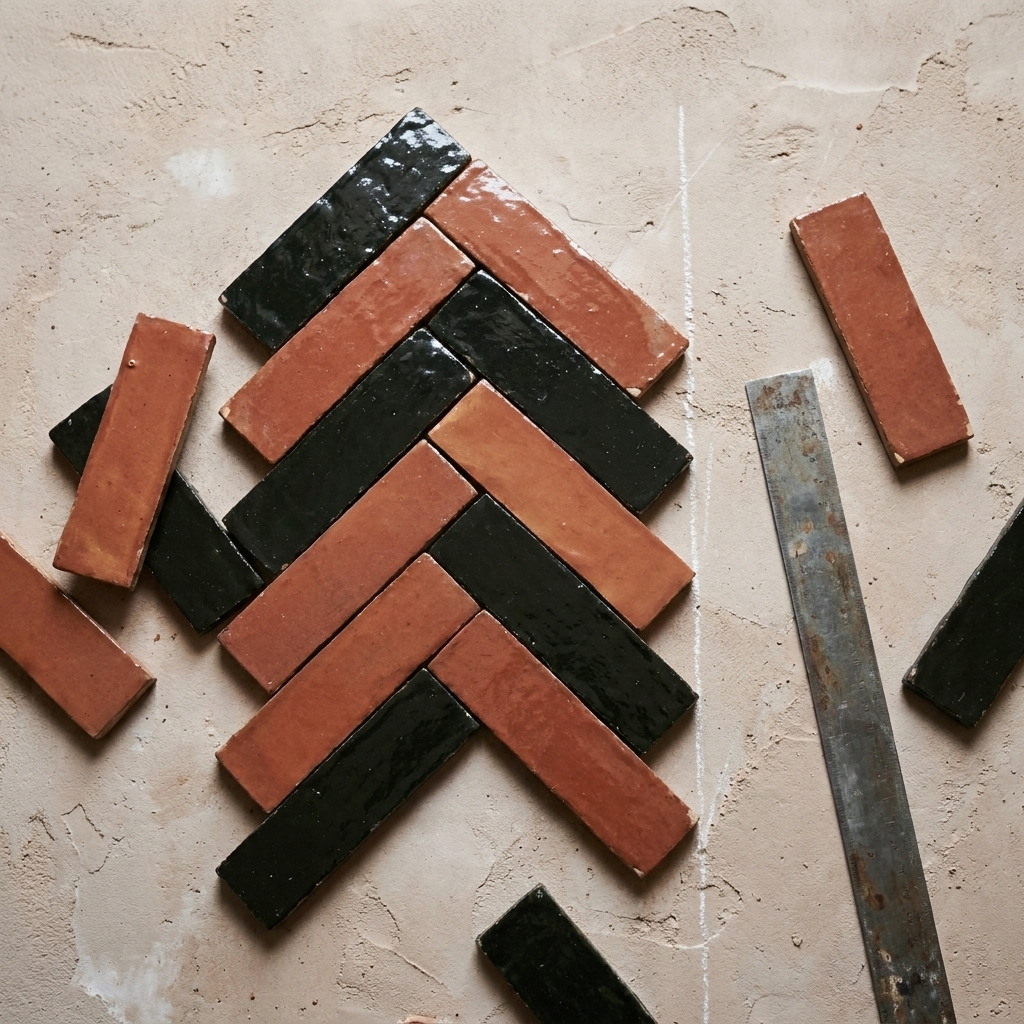
Herringbone sets each tile at a 90-degree angle to its neighbor, forming a zigzag V pattern down the field. It's a traditional European and Moroccan floor pattern, and it works with bejmat because the tiles butt against each other in straight 90-degree joints rather than meeting at a mitered point, a distinction that matters more than it sounds. A butt joint absorbs a small amount of dimensional variation without looking wrong. A mitered joint, where two edges are cut at an angle to meet in a clean point, can't hide that same variation, which is exactly why chevron doesn't work for bejmat and herringbone does.
Expect more waste than running bond or a grid, typically 10 to 15 percent more from perimeter cuts, since every row meeting a wall needs an angled cut. Budget accordingly, and start at the most visible corner of the room so any inconsistency ends up at a wall, not in the middle of the field.
Why Doesn't Chevron Work Well With Bejmat?
Chevron looks similar to herringbone at a glance, but the tiles are pre-cut at a 45-degree angle so they meet in a continuous, unbroken V rather than a stepped zigzag. That mitered point is the problem: it needs every tile to hit the same precise dimension so the angled cuts align edge to edge with no gap.
Bejmat is hand-pressed and kiln-fired, which is exactly what gives it the texture that makes zellige and bejmat desirable in the first place, but it also means no two tiles are perfectly identical in size. On factory-made porcelain with tolerances measured in fractions of a millimeter, chevron is straightforward. On a handmade clay tile, the same small variation that reads as character in a running bond floor reads as a mistake at a chevron point, since the angled edges won't sit flush.
If you love the chevron look, a factory-made porcelain option will get you there more reliably. For handmade bejmat, herringbone gives a closely related zigzag effect without fighting the material.

A deep, lustrous black glaze with a reflective surface that shifts in changing light, striking in a herringbone or running bond layout.
Why Is Basket Weave a Risky Choice for Bejmat?
Basket weave alternates the orientation of tiles, usually in pairs, to create a woven texture. It's a classic pattern, but it's built around near-square modules, typically two tiles side by side to roughly match the length of one tile turned the other way. Bejmat's 3 to 1 ratio doesn't divide that cleanly, so the weave illusion is harder to read than with a more square-proportioned tile.
There's also a technical issue over a larger floor. According to tile layout guidance from the National Tile Authority, grout joint alignment in basket weave has to be carefully planned because minor dimensional inconsistencies accumulate across the field into a visible drift, and on a handmade tile where every piece varies slightly, that drift shows up faster than with machine-made tile.
Basket weave isn't impossible with bejmat, but it takes an installer experienced with handmade tile and careful batch mixing to keep the drift under control. For most kitchens and bathrooms, running bond or a grid gets a comparable textured look with far less risk.
What Grout and Joint Spacing Should You Use With Bejmat?
Traditionally, bejmat is laid edge to edge or with a very tight joint, closer to how brick is laid than the wider spacing used for machine-made floor tile. Grout is then applied with a grout bag rather than a float, which keeps it out of the porous clay surface and reduces staining. Match your grout color to the tile rather than contrasting it: a tight joint in a matched grout lets the wall or floor read as one continuous surface with color variation, the effect that makes bejmat look intentional instead of patchy.
For unglazed bejmat, seal before grouting and again after the grout fully cures, using a penetrating sealer rather than a topical coating, then reseal every one to two years on floors or in wet areas. Glazed bejmat needs less maintenance but still benefits from an initial seal on floors.
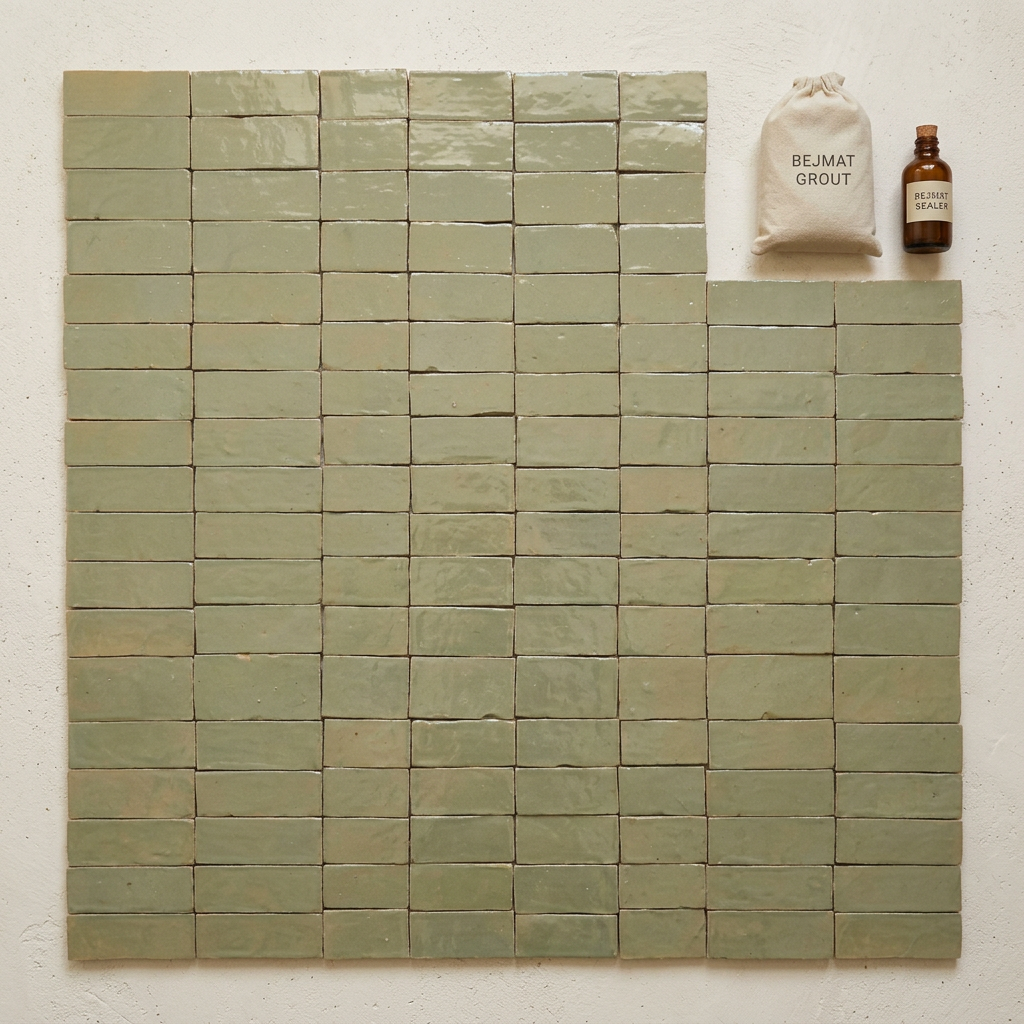

A soft pale green glaze with warm olive undertones, a calm choice for a straight grid in a modern kitchen.
Frequently Asked Questions
What is the best pattern for bejmat tile?
Running bond is the most traditional and forgiving choice for bejmat's 3 to 1 brick shape. A straight grid is the simplest to install, and herringbone gives you more visual movement at the cost of extra waste from cuts.
Can you lay bejmat in a chevron pattern?
Not recommended. Chevron needs mitered tile points cut to a precise, consistent dimension, and bejmat's handmade variation makes that clean point difficult to achieve. Herringbone gives a similar zigzag effect with simple butt joints instead.
How much grout joint should I leave between bejmat tiles?
Bejmat is traditionally laid edge to edge or with a very tight joint, closer to brick spacing than standard floor tile. Grout is applied with a grout bag in a color matched to the tile.
Does bejmat need to be sealed?
Unglazed bejmat should be sealed with a penetrating sealer before grouting and again after the grout cures, then resealed every one to two years in wet or high-traffic areas. Glazed bejmat needs less, but an initial seal is still worth it on floors.
How much extra bejmat should I order for a patterned installation?
For running bond or a straight grid, order 10 to 15 percent extra for cuts and layout control. For herringbone, budget closer to 15 to 20 percent given the additional perimeter cuts the pattern requires.
Find Your Bejmat Pattern
Handmade in Fes, Morocco, in six colors from $19 per square foot.
Shop Bejmat Tile →Samples available before you commit.